Using AI to Plan, Teach, and Reflect - Custom Copilot Agent Transforms Lesson Design at GEMS Winchester School, Dubai

In Short:
Teachers use a custom Copilot agent to design lessons aligned with cognitive science
Using AI to strengthen instructional precision, reduce admin burden, and embed
evidence-based teaching techniques
Apply Willingham’s Memory model, Rosenshine’s Principles of instruction, retrieval Practice, Cognitive science systematically
Reflect on how AI amplifies teacher expertise without replacing pedagogical judgment

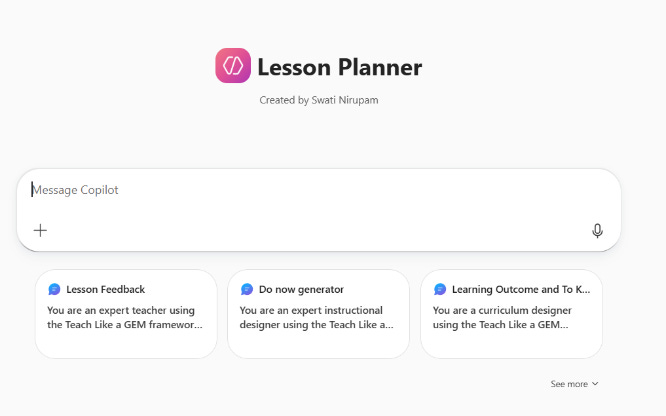
At GEMS Winchester School, we are innovating how lesson planning looks in an AI age. Our teachers have been using a custom Copilot agent, a purpose-built tool that transforms how educators design instruction and embed the science of learning into daily practice. This AI agent is structured around Daniel Willingham’s cognitive principles and Doug Lemov’s proven classroom techniques, which our school has adapted into our planning and delivery model. With intelligent prompting, teachers turn every planning session into an opportunity to develop essential instructional skills: precision, consistency, differentiation, and reflection. The agent guides teachers through every stage of lesson design, helping them move from “filling in a template” to “thinking pedagogically through.” Teachers hence use AI to deepen instructional quality and practice deliberate planning.
From Theory to Practice: How It Looks in the Classroom
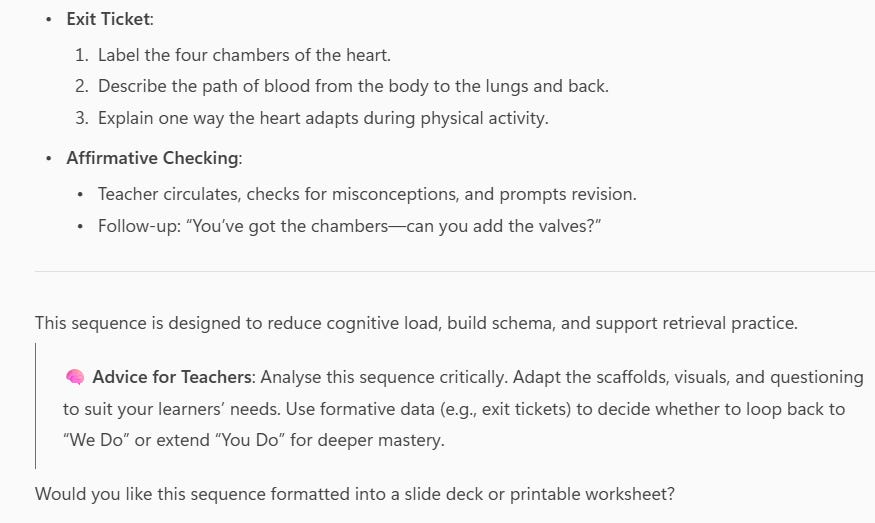
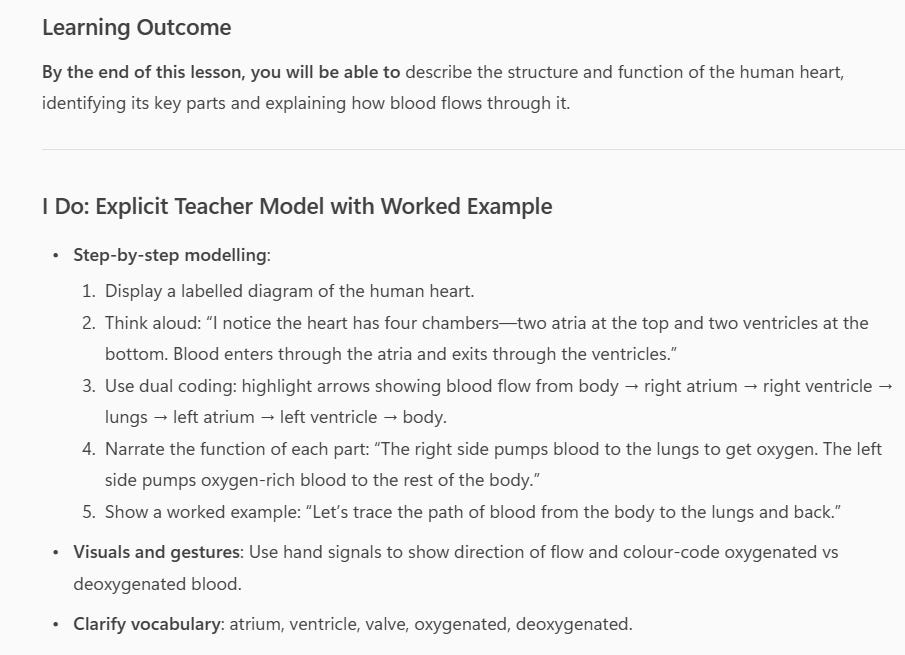
Teachers explored the AI agent across several planning scenarios:
Curriculum-Aligned Outcomes: Inputting year group and topic (e.g., “Year 6 Circulatory system”) and receiving pre-generated learning outcomes focusing on procedural knowledge or skills to be gained and “To Know” essentials that are factual or conceptual knowledge components aligned with our curriculum standards.
Technique Integration: The agent suggests specific Lemov’s techniques at strategic points (e.g., “Use Cold Call after explaining mitochondria function to ensure all students are processing the concept”).
Cognitive Load Management: Lessons are automatically structured to avoid working memory overload, with content chunked appropriately and retrieval practice embedded at intervals.
Generating feedback comments: Copilot agent creates feedback comments that help students correct and improve their responses and suggest a follow up challenge question.
Each activity reinforced the same core idea: better planning leads to better teaching, and better teaching leads to better learning outcomes. Teachers use P.R.O.M.P.T : (Precise, Role-Based, Outcome-Oriented, Medium-Specific, Provide Context, Test & Refine ) framework to query custom copilot agent. A pre - designed prompt bank is developed and integrated with copilot agent to support teachers with using the agent.
Real Teacher Scenarios: Before & After Using the Agent
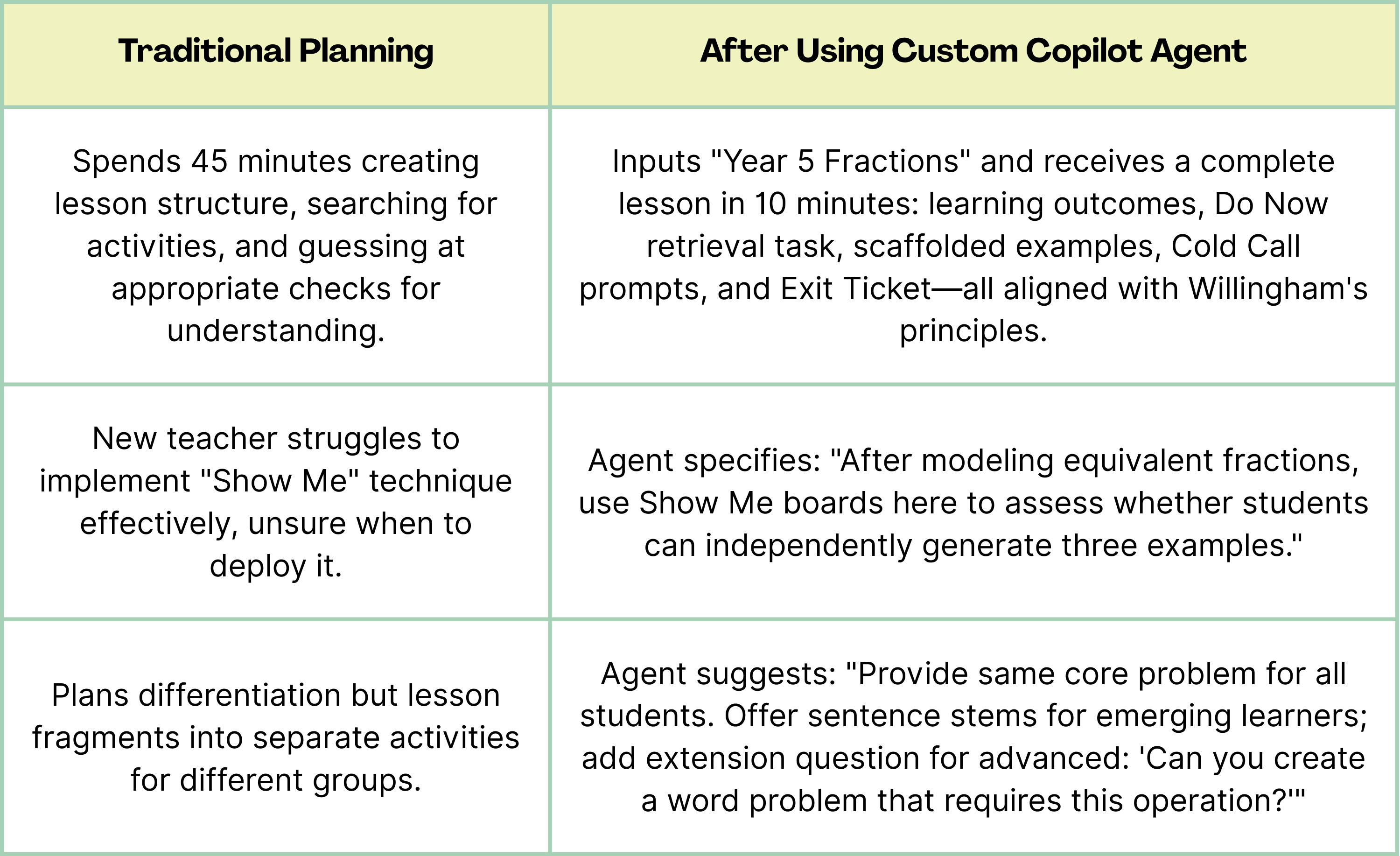
After using the agent, teachers quickly noticed how AI-embedded cognitive science transformed their instruction from generic to genuinely impactful.
Metacognition Moments
Reflecting after implementation, teachers shared insights about their planning process, what we call Metacognition Moments:
“I realized my original lessons weren’t strategically checking for understanding. The agent showed me where to pause and assess, not just at the end.”
“When I use the Copilot agent, my lessons feel impactful. It’s like having an instructional coach reminding me why each component matters.”
“Seeing Lemov techniques embedded in context helped me understand when to use them, not just what they are.”
These reflections align beautifully with WSD’s commitment to evidence-based teaching, purposeful AI integration for learning & teaching and embedding the science behind instruction into every planning session.
Why a Custom Copilot Agent Matters?
Emerging research tells us that AI integration in education is not just a nice-to-have—it’s transformative when purpose-built. Generic Most AI tools lack pedagogical grounding, but custom agents trained on specific instructional models can systematically apply what we know works. Our agent embeds:
Willingham’s cognitive principles: Lessons are designed to activate prior knowledge, manage working memory, and promote long-term retention through spaced retrieval.
Lemov’s techniques: Strategic deployment of Cold Call, Check for Understanding, Ratio, and other high-leverage moves at optimal moments.
School-specific adaptations: Our refined approaches to adaptive teaching, assessment, and curriculum sequencing.
In our whole-school instructional program, we emphasize the cycle of plan → teach → reflect → refine. Using AI in planning mirrors that cycle: teachers review agent output, personalize for their students, teach the lesson, and reflect on effectiveness. So, the Copilot agent becomes an extension of professional development, not a separate add-on.
The Benefits: Time, Precision, and Growth
Time Savings: What once took 45 minutes now takes 10. Teachers review, adjust, and personalize rather than building from scratch.
Instructional Consistency: Every teacher, regardless of experience, plans lessons rooted in cognitive science and proven techniques.
Reduced Cognitive Load for Teachers: With planning streamlined, teachers have bandwidth for responsive teaching, the real-time adjustments that no AI can predict.
Continuous Professional Learning: Teachers see exemplar planning daily, internalizing the science of learning through repeated exposure.
Focus on art of teaching: By handling structural rigor, the agent frees teachers to focus on relationships, culture-building, and in-the-moment pedagogical decisions.
Looking Ahead
Going ahead, teachers will extend their use of the Copilot agent across subjects from science to humanities to languages, applying evidence-based strategies in every lesson they design. At GEMS Winchester School, purposeful and pedagogically grounded AI drives our approach to innovation. We are guiding teachers to plan with intention, integrating AI carefully and strategically into the heart of meaningful instruction. Leaders ensure AI enhances teaching with purpose, precision, and reflection; never replacing teacher expertise, always amplifying it.
References
Willingham, D. T. (2009). Why Don’t Students Like School? A Cognitive Scientist Answers Questions About How the Mind Works and What It Means for the Classroom. Jossey-Bass.
Lemov, D. (2015). Teach Like a Champion 2.0: 62 Techniques That Put Students on the Path to College. Jossey-Bass.
Zawacki-Richter, O., & Anderson, T. (2025). AI Integration in Educational Practice: Implications for Teacher Planning. Educational Technology Review, SpringerOpen.