Using AI to Think, Create, and Reflect - Year 6 Learners Level Up with Prompt Engineering at GEMS Winchester School, Dubai (WSD)


Learning Outcomes
To use the WSD P.R.O.M.P.T. Framework to create with purpose
Strengthen clarity, critical thinking, creativity, and literacy by using structured queries.
Compare AI-generated and real images to build media awareness
Reflect on how your thinking shapes technology.

At Gems Winchester School , we are innovating how literacy looks like in an AI age. Our Year 6 learners have been using the P.R.O.M.P.T. framework which is a six-part structure that transforms how students interact with technology and exercise their cognitive muscles. With correct prompting students turn every query into an opportunity to develop essential skills: critical thinking, confidence, collaboration, creativity, communication, curiosity, and consciousness. The framework - Precise, Role-Based, Outcome-Oriented, Medium-Specific, Provide Context, Test & Refine guides students through every stage of working with AI, helping them move from “typing something in” to “thinking something through.” Students hence use AI to deepen creativity and practice metacognition.
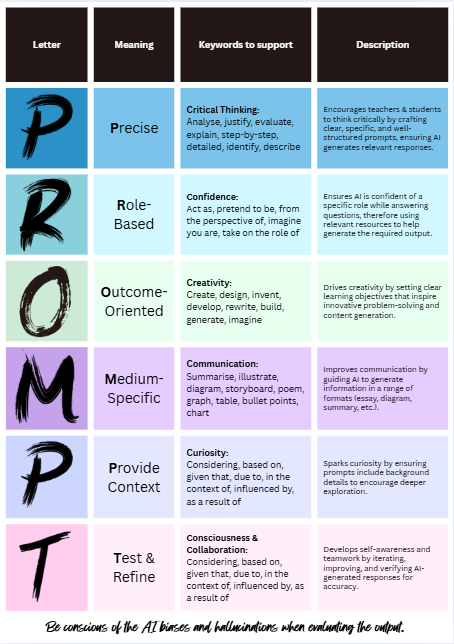
From Text to Thinking: How it looked in the classroom : Students explored AI across several group challenges
Story-Prompting: Writing prompts that asked AI to generate a short story, then evaluating the output and adjusting their prompts.
Character & Visualisation: Using Canva for education to generate images of characters based on descriptive prompts, then comparing how the AI interpreted their language.
Image Comparison Project: Students used the P.R.O.M.P.T framework to generate AI-created images and then compared them with real photographs, sparking discussion about how language shapes AI’s “vision” and how our human descriptions differ from what machines produce.
Each activity reinforced the same core idea: better thinking leads to better prompting and better prompting leads to better learning and AI generated outcomes. Throughout, students were encouraged to think metacognitively: “What did my prompt do? What might I change next time? Why did the AI respond like that?” That kind of self-reflection is exactly the kind of mindful AI integration work we aim to embed across the school.
👩🏽💻 Real Student Scenarios: Before & After Prompts
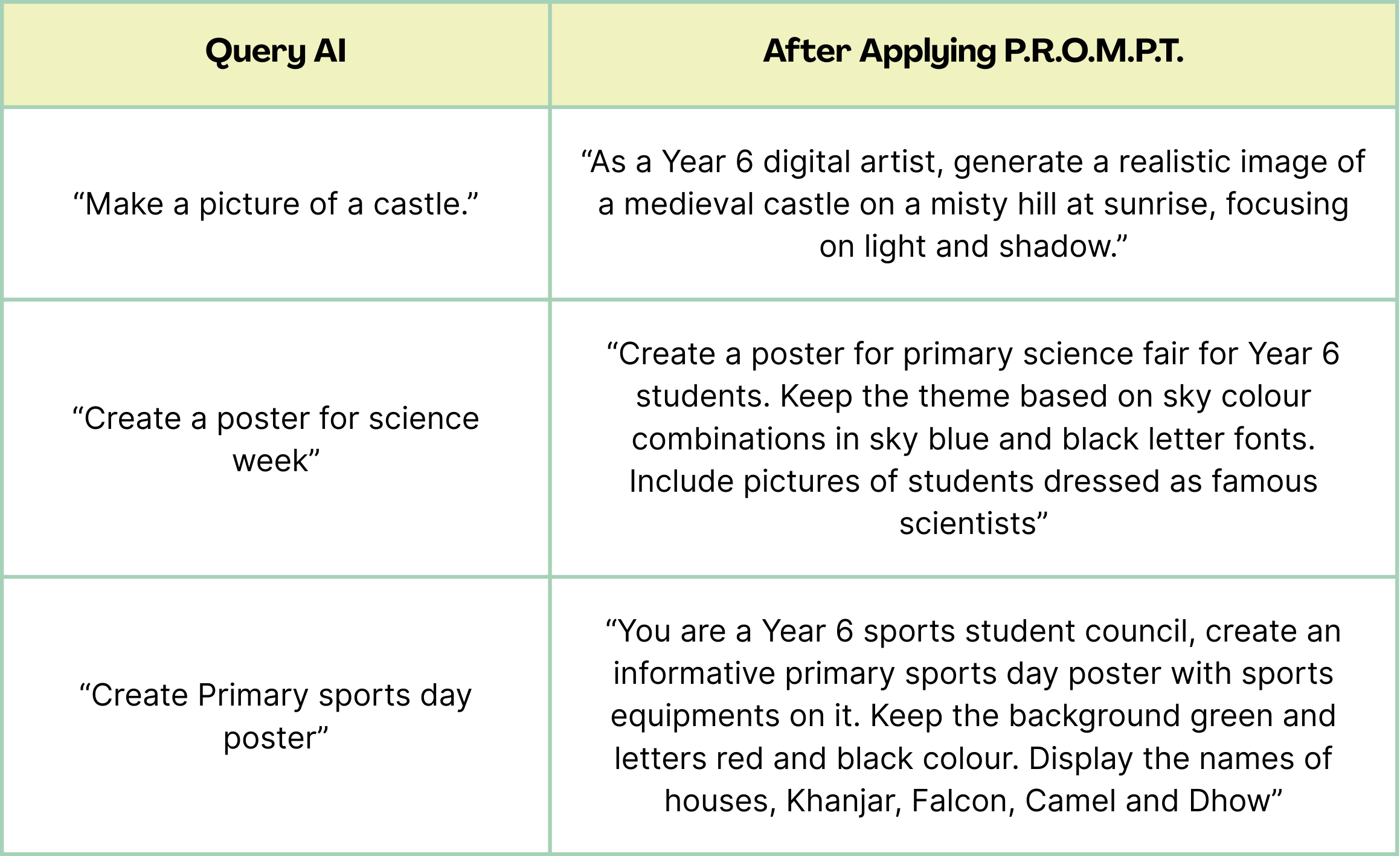
After co-creating the prompts , students quickly noticed how small changes in precision and context transformed the instruction given to AI. Students used Canva education to generate images and discussed the change of AI’s results from generic to genuinely creative.
💭 Metacognition Moments
Reflecting after each task, students shared insights about their own thought process, what we call Metacognition Moments:
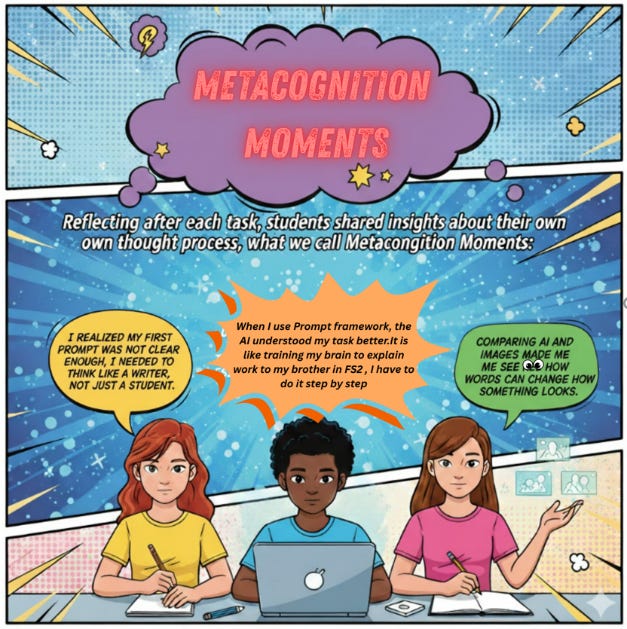
“I realised my first prompt was not clear enough , I needed to think like a writer, not just a student.”
“When I use Prompt framework, the AI understood my task better. It is like training my brain to explain work to my brother in FS2 , I have to do it step by step and clearly.”
“Comparing AI and real images made me see how words can change how something looks.”
These reflections align beautifully with WSD’s literacy guidance, embedding the thinking behind language into every AI interaction.
Why P.R.O.M.P.T matters?
Emerging research tells us that prompt engineering is not just a nice to have rather it’s a key competency for the AI age. One systematic review found that “well-designed prompts have the potential to transform interactions with generative AI and need to be aligned with predetermined educational goals.” (Zawacki-Richter & Anderson, 2025). Another study of “prompt literacy” with language learners found learners improved not only their ability to craft prompts, but also their vocabulary, communication strategies and metacognitive awareness (Liu et al., 2024).
In our whole-school literacy programme, we emphasise the cycle of draft → refine → publish. Using prompts in the classroom mirrors that cycle: students draft, test, refine (feedback from AI or peers), and publish or evaluate. So prompt engineering becomes an extension of literacy, not a separate add-on.
Looking Ahead
Next term, Year 6 will extend their prompting skills across subjects ,from generating scientific explanations to visualising historical events applying literacy strategies in every prompt they craft. At GEMS Winchester School, purposeful and personalised learning drives our approach to AI. We are guiding students to learn with intention, integrating AI carefully and creatively into the heart of meaningful education. Teachers ensure AI enhances education with purpose, precision, and reflection.
References
Hayes, L., Nguyen, P., & Allen, T. (2024, May). Developing Critical Thinking through AI-Enhanced Prompt Writing. Association for Learning Technology Conference (ALT-C). Retrieved from https://altc.alt.ac.uk
Zawacki-Richter, O., & Anderson, T. (2025). Prompt Engineering in Higher Education: A Systematic Review. Educational Technology Review, SpringerOpen. https://educationaltechnologyjournal.springeropen.com/articles/10.1186/s41239-025-00503-7
Liu, X., Chen, Y., & Park, E. (2024). Prompt Literacy: How Language Learners Build AI-Mediated Communication Skills. arXiv preprint arXiv:2311.05373.